Bridge Progression: From Shoulder Bridge to Full Bridge
To do a full bridge, lie on your back with your hands by your ears and your feet flat, then push until your arms are straight and your hips are high, opening the shoulders rather than bending the lower back. Build it from the reverse plank and the shoulder bridge through table, angled and head bridges.
- Realm
- The Handstand
- Steps
- 11
- Grades
- White to Blue
- Gear
- floor
The bridge, also called the back bridge or wheel pose, is an arch held on straight arms and planted feet, the front of your body turned to the ceiling. Done well, the bend is shared: the shoulders open overhead and the glutes drive the hips up, so the lower back only carries its part. Done badly, the arch piles into the lumbar spine. This chain exists to teach the first version.
Calisthenics spends most of its time in hollow, rounded shapes, and the bridge trains the opposite one. The overhead shoulder range it builds is the same range a straight, stacked handstand needs. It also keeps your spine comfortable bending backward under control, a range many adults stopped using long before they started training.
Every step is a hold, and every standard is the same, 3 × 20–30s, so the chalk grade tells you how hard each shape is. White builds the shape from the ground up, starting with the Reverse Plank and Shoulder Bridge and ending with the Head Bridge. Green is the Full Bridge, then the Decline Bridge and one-leg versions that load it harder. Blue takes an arm away with the OA Head Bridge and the OA Bridge.
Standards
What passing each step takes, per set. Hold seconds for static moves, reps for dynamic ones; the chalk gates are the six-gate grades of /levels.
| # | Step | Grade | To pass | Chalk gate |
|---|---|---|---|---|
| 1 | Reverse Plank | White | 3 × 30 s | · |
| 2 | Shoulder Bridge | White | 3 × 30 s | · |
| 3 | Table Bridge | White | 3 × 30 s | · |
| 4 | Angled Bridge | White | 3 × 30 s | · |
| 5 | Head Bridge | White | 3 × 30 s | · |
| 6 | Full Bridge | Green | 3 × 30 s | · |
| 7 | Decline Bridge | Green | 3 × 30 s | · |
| 8 | One Leg Bridge | Green | 3 × 30 s | · |
| 9 | Decline OL Bridge | Green | 3 × 30 s | · |
| 10 | OA Head Bridge | Blue | 3 × 30 s | · |
| 11 | OA Bridge | Blue | 3 × 30 s | · |
The ladder
Every step has a standard. Own it, then climb. Grades run White, Green, Blue, Yellow, Red. Mark where you are: it saves to your skill tree.
- 01Reverse PlankWhite3 × 20–30s hold
 No number logged yetStandard: 30 s a set
- 02Shoulder BridgeWhite3 × 20–30s hold
 No number logged yetStandard: 30 s a set
- 03Table BridgeWhite3 × 20–30s hold
 No number logged yetStandard: 30 s a set
- 04Angled BridgeWhite3 × 20–30s hold
 No number logged yetStandard: 30 s a set
- 05Head BridgeWhite3 × 20–30s hold
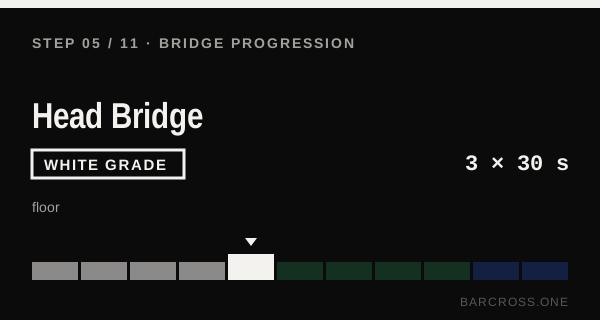 No number logged yetStandard: 30 s a set
- 06Full BridgeGreen3 × 20–30s hold
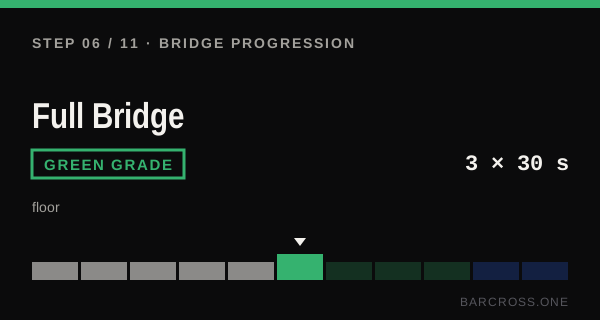 No number logged yetStandard: 30 s a set
- 07Decline BridgeGreen3 × 20–30s hold
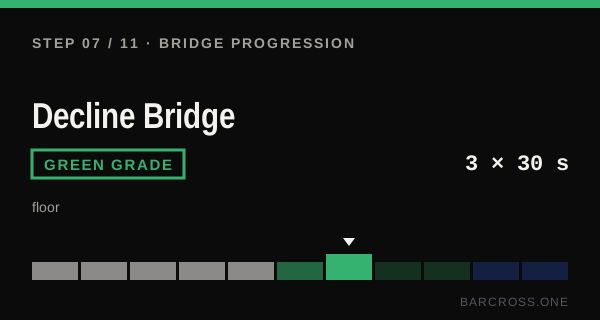 No number logged yetStandard: 30 s a set
- 08One Leg BridgeGreen3 × 20–30s hold
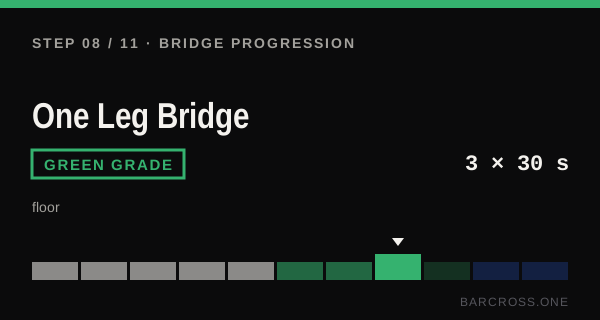 No number logged yetStandard: 30 s a set
- 09Decline OL BridgeGreen3 × 20–30s hold
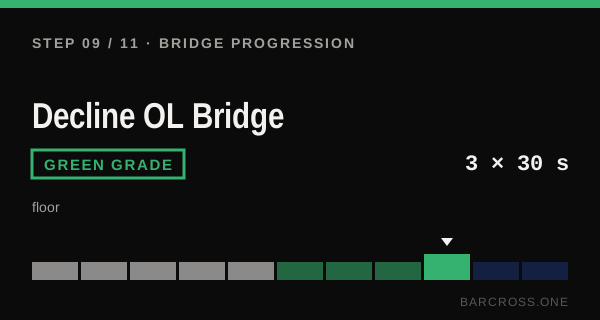 No number logged yetStandard: 30 s a set
- 10OA Head BridgeBlue3 × 20–30s hold
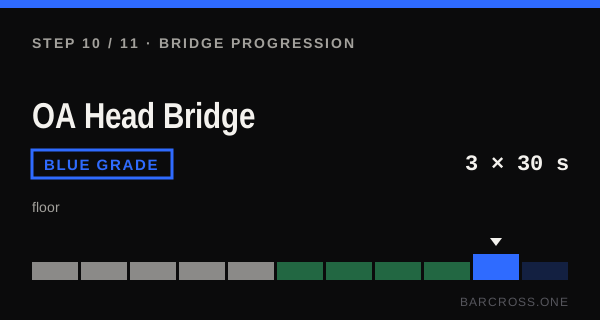 No number logged yetStandard: 30 s a set
- 11OA BridgeBlue3 × 20–30s hold
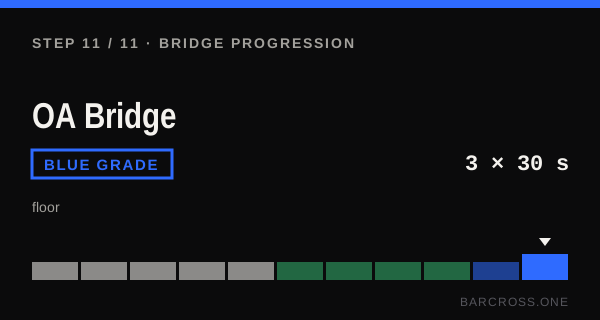 No number logged yetStandard: 30 s a set
How to climb it
Move up when the current step holds for 3 × 20–30s with steady breathing and no pinch in the lower back. On BARCROSS, holds run a ladder: 3 × 10s to start, five seconds more each session, and at 3 × 30s you move to the next bridge. Two or three sessions a week is plenty, placed late in the session when your shoulders and hips are already warm.
Prepare before every attempt. Open the shoulders with arm circles and a stretch against a wall, and loosen the hip flexors with a lunge, so the arch has more places to come from. Press up slowly and come down slowly, chin tucked. In the head bridges, keep most of the weight in your hands and feet. If pain persists, see a professional.
Form cues
- Open the shoulders first, not the lower back
- Push through the shoulders, retract the scapulae, lift the chest
Common mistakes
- Bending from the lower back: when the shoulders stay closed, the arch piles into the lumbar spine, and that is where bridges start to hurt.
- Soft elbows: bent arms let the chest sink back toward the floor, and the shoulders never get the stretch the bridge is there to give.
- Skipping the White steps: the early bridges teach the shoulders and glutes to share the work before the Full Bridge asks for all of it at once.
- Holding your breath: if you cannot breathe in the hold, you are past today's range, so ease off and let the seconds come.
- Rushing the one-arm steps: taking a hand away adds a twist the two-arm bridge never asked for, so own every two-arm version first.
Questions
Is the bridge bad for your back?
Not when the shoulders and hips do their share. Trouble usually starts when closed shoulders force the whole arch into the lower back, which is why this chain opens the shoulders first. Build range gradually, never force a position, and if pain persists, see a professional.
How long does it take to do a full bridge?
It depends on the shoulder and hip range you bring. Some people press into a Full Bridge within a few weeks; stiffer adults can need many months of regular work. Steady practice two or three times a week moves it faster than one long, forced session.
Is a bridge the same as wheel pose?
Yes, it is the same shape. Wheel pose is the yoga name; in calisthenics it is the full bridge or back bridge. This chain trains it as a strength hold, with a clear standard at every step.
Why do my wrists hurt in a bridge?
Your wrists are bent back with a lot of weight over them, and tight shoulders make it worse because the arms slant and bend the wrists further. Warm them up before you bridge, spend more time on the earlier steps, and let shoulder range take the strain off over time. If pain persists, see a professional.
The chain follows the r/bodyweightfitness progressions chart. Standards, grades and words: BARCROSS.