Elbow Lever Progression: From Plank to One Arm
To do an elbow lever, crouch with your hands on the floor, dig your elbows into your hips or belly, and lean forward until your legs float, then hold your body level, balanced on your hands. Start from a plank and a straddle one-arm plank, then hold straddle and one-leg elbow levers before the full one.
- Realm
- The Planche
- Steps
- 8
- Grades
- White to Yellow
- Gear
- bar, rings, floor
In an elbow lever your bent arms become a shelf. The elbows tuck against your hips and your straight body rests on them, level with the floor, with only your hands touching down. With the elbows doing the carrying, it is far more approachable than the planche: the Elbow Lever sits at Green, the full Planche at Red.
It teaches two things the bigger balances need. You learn to find a balance point over your hands with your whole body off the floor, and you learn to keep that body rigid while it is horizontal. It also gets your wrists and forearms used to carrying load, useful groundwork for the planche chain later.
The chain is short and mostly Green, the second of five chalk grades. White is the Plank, the base for a rigid body. Green builds the balance: the Straddle One Arm Plank, the Straddle Elbow Lever and One Leg Elbow Lever, then the full Elbow Lever. Blue moves it onto rings and starts the one-arm version with the legs straddled, and Yellow is the One Arm Elbow Lever with the legs together. Every standard is 3 × 20–30s.
Standards
What passing each step takes, per set. Hold seconds for static moves, reps for dynamic ones; the chalk gates are the six-gate grades of /levels.
| # | Step | Grade | To pass | Chalk gate |
|---|---|---|---|---|
| 1 | Plank | White | 3 × 30 s | · |
| 2 | Straddle One Arm Plank | Green | 3 × 30 s | · |
| 3 | Straddle Elbow Lever | Green | 3 × 30 s | · |
| 4 | One Leg Elbow Lever | Green | 3 × 30 s | · |
| 5 | Elbow Lever | Green | 3 × 30 s | · |
| 6 | Ring Elbow Lever | Blue | 3 × 30 s | · |
| 7 | OA Straddle Elbow Lever | Blue | 3 × 30 s | · |
| 8 | One Arm Elbow Lever | Yellow | 3 × 30 s | · |
The ladder
Every step has a standard. Own it, then climb. Grades run White, Green, Blue, Yellow, Red. Mark where you are: it saves to your skill tree.
- 01PlankWhite3 × 20–30s hold
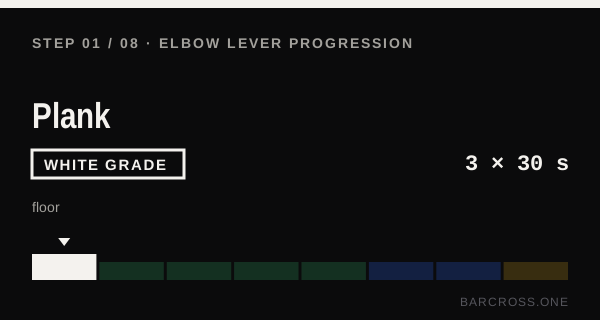 No number logged yetStandard: 30 s a set
- 02Straddle One Arm PlankGreen3 × 20–30s hold
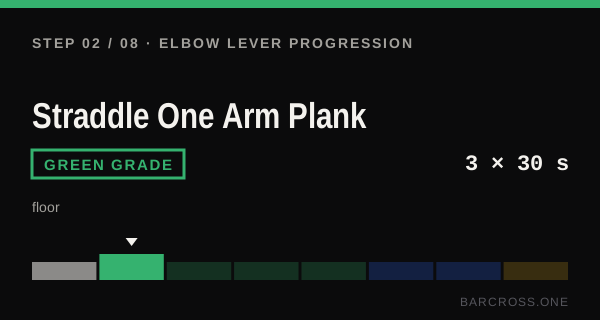 No number logged yetStandard: 30 s a set
- 03Straddle Elbow LeverGreen3 × 20–30s hold
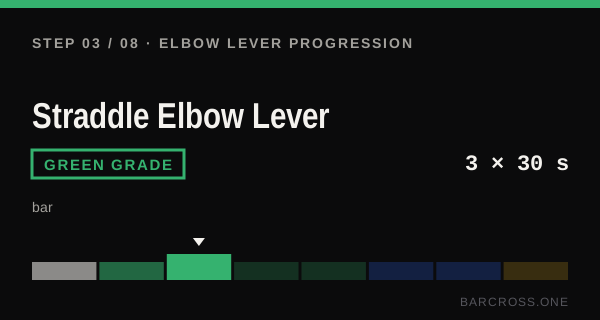 No number logged yetStandard: 30 s a set
- 04One Leg Elbow LeverGreen3 × 20–30s hold
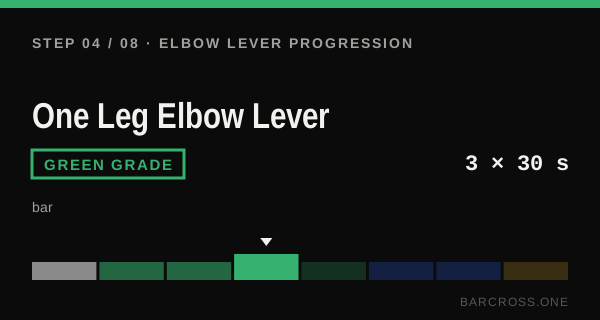 No number logged yetStandard: 30 s a set
- 05Elbow LeverGreen3 × 20–30s hold
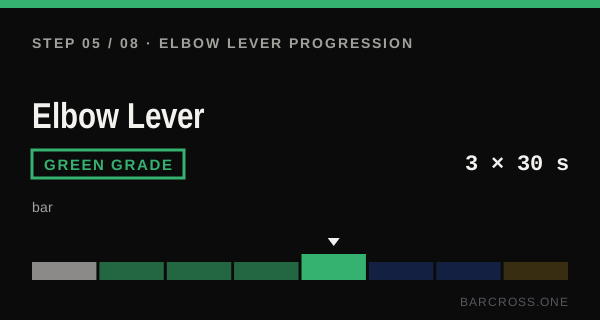 No number logged yetStandard: 30 s a set
- 06Ring Elbow LeverBlue3 × 20–30s hold
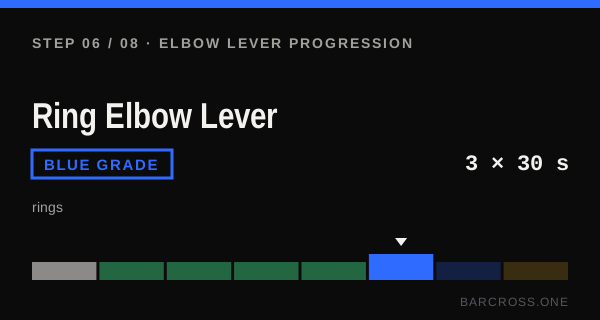 No number logged yetStandard: 30 s a set
- 07OA Straddle Elbow LeverBlue3 × 20–30s hold
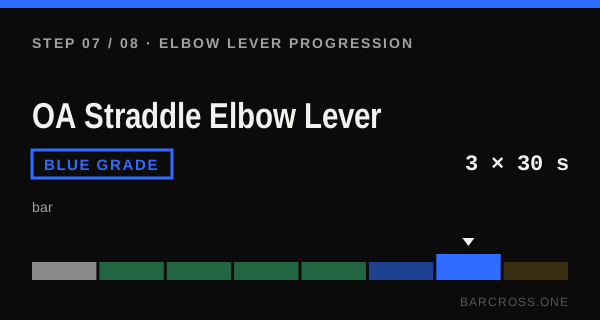 No number logged yetStandard: 30 s a set
- 08One Arm Elbow LeverYellowSame video as the straddle version. The difference is the legs: straddle wide first, then squeeze them together over time — legs together is the full move.3 × 20–30s hold
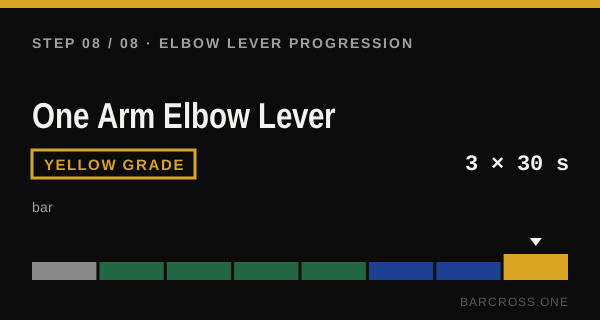 No number logged yetStandard: 30 s a set
How to climb it
Move on when you own 3 × 20–30s at the current step. On BARCROSS, holds run a ladder: 3 × 10s at first, five seconds more each session, and at 3 × 30s you move to the next step. Because the elbow lever is mostly balance, it rewards short practice: a few attempts early in two or three sessions a week, while your wrists and focus are fresh.
Warm up your wrists before every session, since your hands take your whole weight bent back. Put a soft mat in front of you while you learn; tipping forward is the usual beginner exit. If your elbows dig in uncomfortably, move them a little until you find a spot that takes the load without pain, and keep the legs squeezed once you leave the straddle.
Form cues
- Elbows dig into the hips/belly
- Lean until the legs float, balance, then hold
Common mistakes
- Leaning too little: the legs only float once your shoulders move forward past your hands, so a stuck hold usually needs more lean rather than more strength.
- Piking at the hips: dropping the legs to save the balance keeps your feet near the floor, so squeeze the glutes and hold one straight line.
- Elbows sliding wide: once the elbows slip off the hips the shelf disappears, and your arms have to hold you alone.
- Jumping into it: kicking the legs up instead of leaning into the balance turns every hold into a coin toss.
- Rushing the one-arm version: a single hand adds a rotation the two-arm hold never asks for, so own the Ring Elbow Lever before you try it.
Questions
Is the elbow lever hard to learn?
It is one of the more approachable arm balances, graded Green, the same grade as the Crow Pose. It asks more of your balance and wrists than of your raw strength. Many people find the balance point within a few weeks of regular attempts, while the one-arm version takes much longer.
What muscles does the elbow lever work?
Mostly the core, shoulders and forearms, with the wrists taking a big share of the load. The core keeps your body straight while the shoulders and forearms hold the balance. Think of it as a balance and body-tension skill more than a muscle builder.
Is the elbow lever a planche progression?
Not directly. In the elbow lever your elbows rest on your body and carry it; in the planche the arms are straight and only your shoulders hold you up. It is a separate chain in the same realm of the tree, useful early balance work rather than a step on the planche ladder.
How do you do a one arm elbow lever?
Own the two-arm Elbow Lever and the Ring Elbow Lever first. The OA Straddle Elbow Lever comes next, and narrowing the legs over the following weeks and months is the whole road to the One Arm Elbow Lever. Plant the supporting elbow in the same spot on every attempt, because a shelf that moves makes the balance much harder to learn.
The chain follows the r/bodyweightfitness progressions chart. Standards, grades and words: BARCROSS.